Engineering
Engineering the Perfect Hull: The Twin Asymmetrical V
Date
January 20, 2026
Category
Engineering
Read Time
12 min read
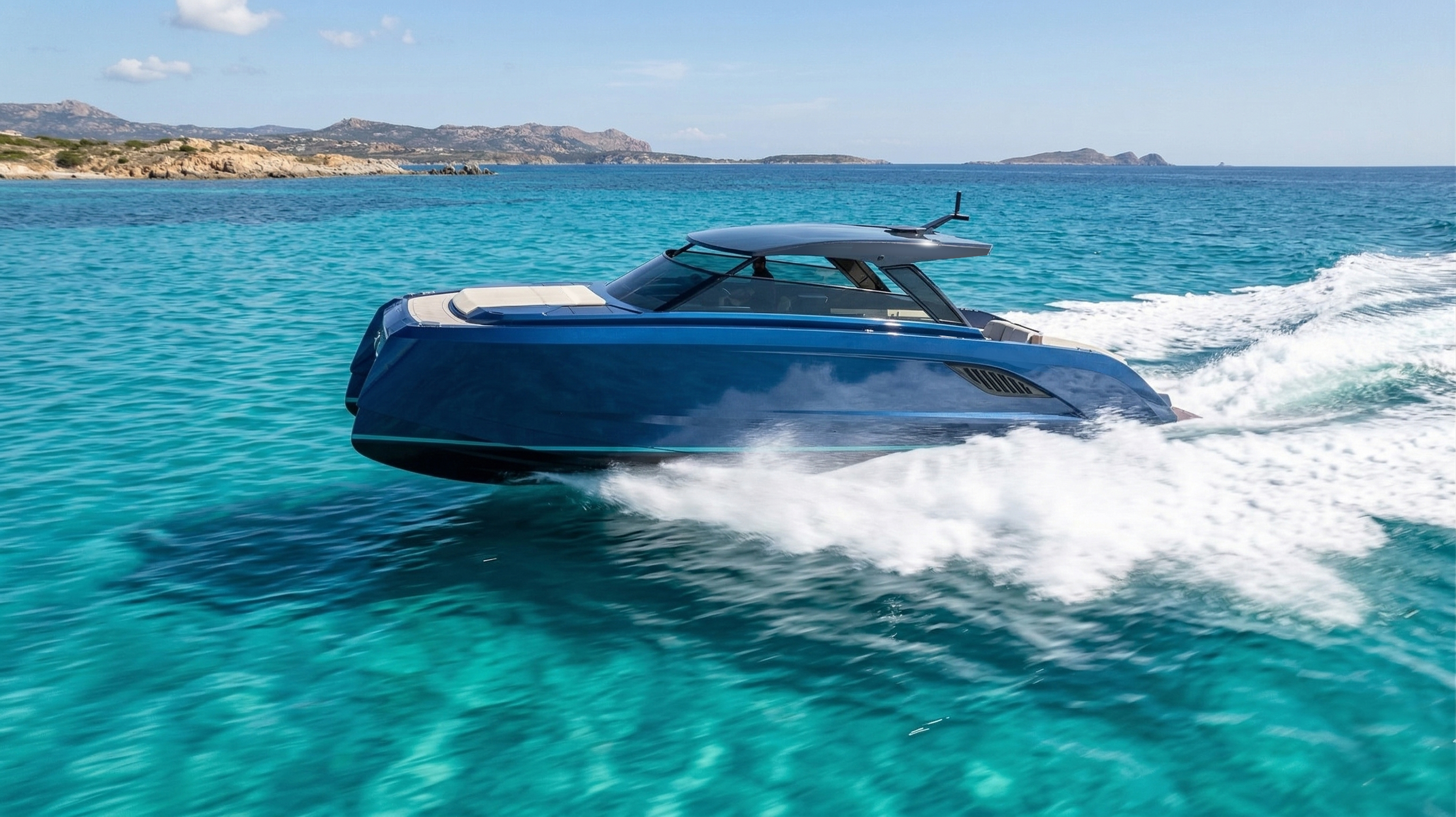
The hull is the single most consequential engineering decision in any performance vessel. For the VYBE 43, achieving 40+ knots while maintaining comfort at cruise was never a matter of adding horsepower — it was a matter of geometry. The twin asymmetrical V hull represents years of computational fluid dynamics, tank testing, and thousands of nautical miles of open-water validation across the most demanding waters of the Mediterranean.
Achieving 40+ knots in a 43-foot yacht while maintaining comfort isn’t a matter of adding horsepower. It’s a matter of hull geometry — the single most consequential engineering decision in any performance vessel. The hull of the VYBE 43 represents years of computational fluid dynamics, tank testing, and thousands of nautical miles of open-water validation across the Mediterranean.
The challenge facing our engineering team was clear: the sport yacht market in the 40-foot class had accepted a fundamental compromise. You could have speed, or you could have comfort. You could have efficiency, or you could have stability. The prevailing wisdom held that these trade-offs were inherent to physics — that they couldn’t be dissolved, only managed. We disagreed.
The Twin Asymmetrical V: A Different Approach
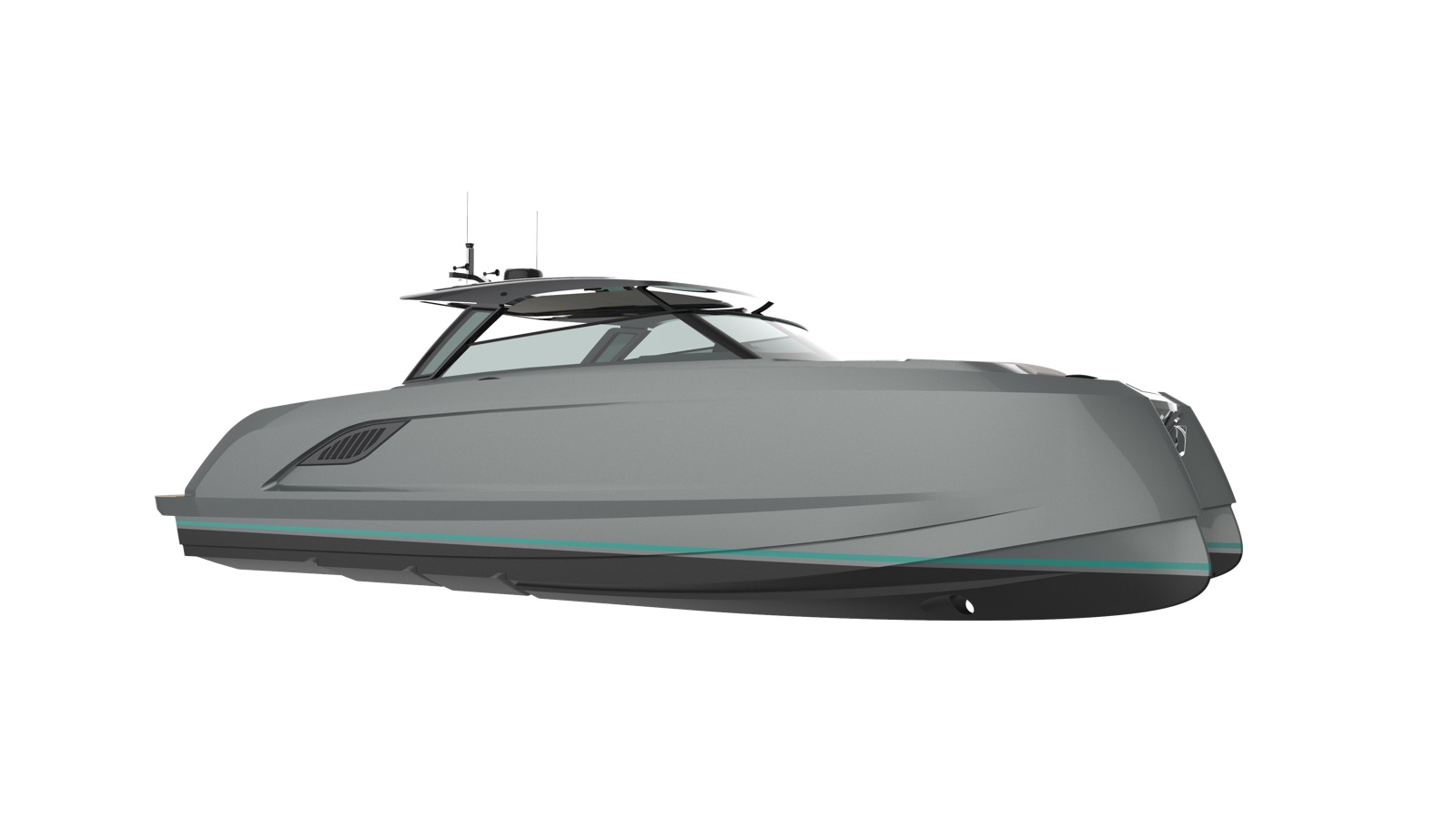
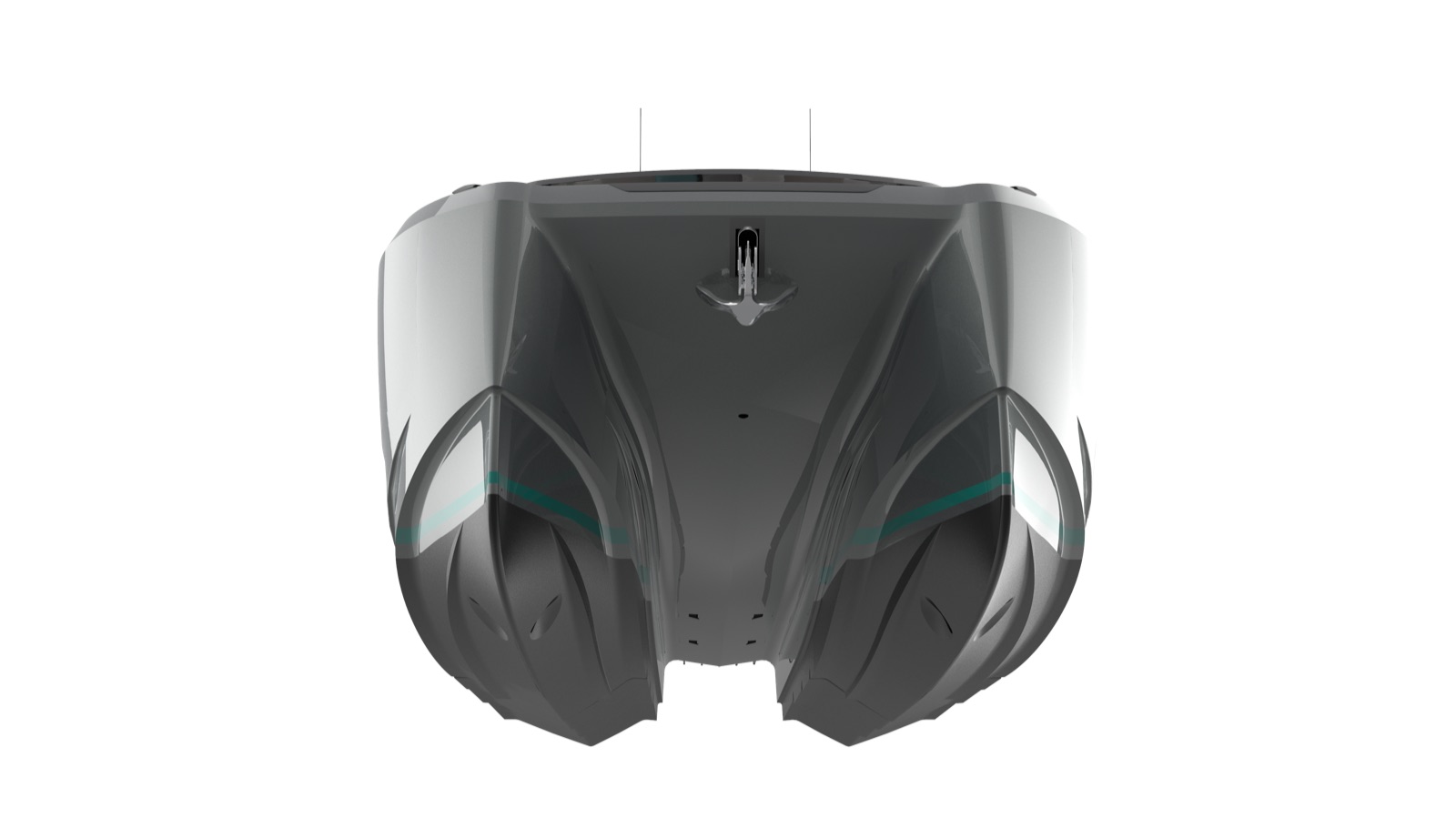
At the core of the VYBE 43 is a twin asymmetrical V hull — a geometry developed not to follow convention but to resolve a fundamental compromise that has defined the sport yacht segment for decades: the trade-off between speed and stability.
Traditional deep-V hulls ride well in head seas but sacrifice efficiency and stability at rest. The deadrise angle that smooths impacts in rough water also means the vessel sits uneasily at anchor, rolling in even modest beam swells. Wider, flatter hulls are stable at anchor but punishing at speed, slamming through waves rather than cutting through them. For decades, designers have shuttled between these extremes, finding acceptable compromises but never a true resolution.
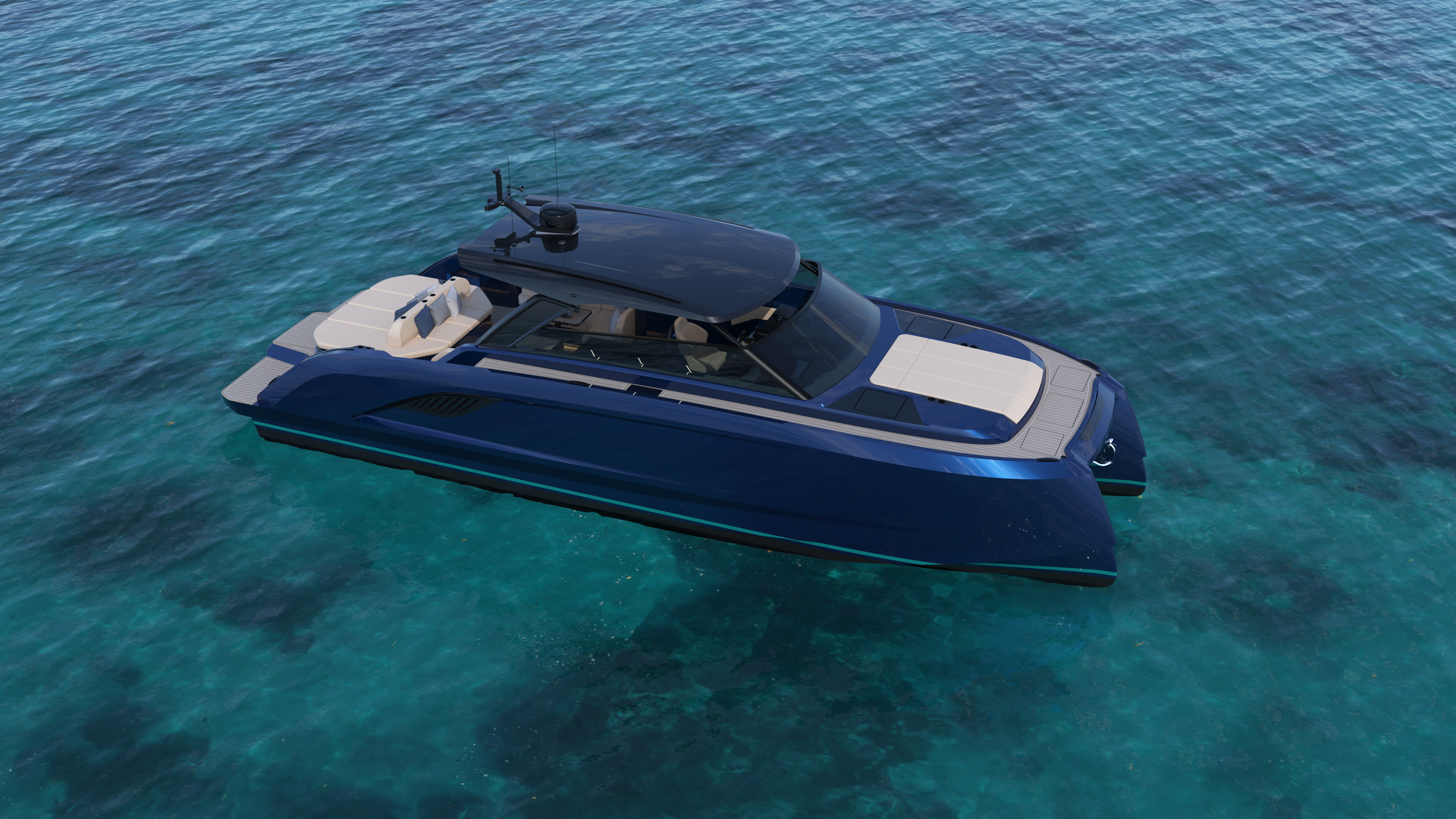
The twin asymmetrical V dissolves this binary by varying the deadrise geometry across two distinct hull sections:
- Inboard surfaces optimised for directional stability and efficient water flow at speed, with sharper deadrise angles that maintain the hull’s tracking in turns and reduce the wetted surface area at planing speeds
- Outboard surfaces shaped for lateral stability and composed behaviour in beam seas, with a flatter geometry that provides the platform stability expected at anchor and during low-speed manoeuvring
- Variable deadrise transitioning from 24° at midship to 18° at the transom, creating a hull that progressively widens its effective planing surface as it accelerates — gaining stability and lift exactly when they’re needed most
The result: a hull that moves naturally through the water rather than forcing its way through. At rest, the VYBE 43 sits with a composure that owners of deep-V sport yachts will find remarkable. At 35 knots, it tracks with a precision that flat-bottom advocates will find impossible. This duality is not a compromise — it’s a resolution.
Computational Precision, Open-Water Validation
The hull shape was developed using advanced CFD (computational fluid dynamics) modelling — the same simulation technology used by America’s Cup syndicates and naval architects working on vessels ten times the VYBE 43’s displacement. The engineering team iterated through over 200 geometry variations before a single physical model was built, each variation tested against a matrix of conditions: head seas, beam seas, quartering seas, flat water sprints, and the confused chop that develops when wind opposes current.
CFD allowed us to visualise pressure distribution across the hull surface at every speed and sea state — identifying areas of excessive resistance, unstable flow separation, and cavitation risk around the running gear. The software doesn’t lie: it reveals compromises that physical intuition might miss, and it does so before a single kilogram of material is committed to a mould.
But simulation alone doesn’t build confidence — the Mediterranean does. Extensive sea trials in the Tyrrhenian Sea, off the coast of Viareggio and into the open waters towards Corsica, validated what the simulations predicted: a hull that maintains composure in confused sea states, delivers predictable handling at speed, and achieves a cruising efficiency that extends range without limiting performance.
The trial programme spanned three months and covered over 2,000 nautical miles, deliberately targeting the most challenging conditions the western Mediterranean offers: the mistral-driven chop of the Ligurian Sea, the open fetch between Elba and Corsica, and the steep, short seas generated by the afternoon thermal winds along the Versilia coast. In every condition, the hull performed within 3% of the CFD predictions — a validation rate that confirmed both the simulation methodology and the construction precision.
Materials and Construction
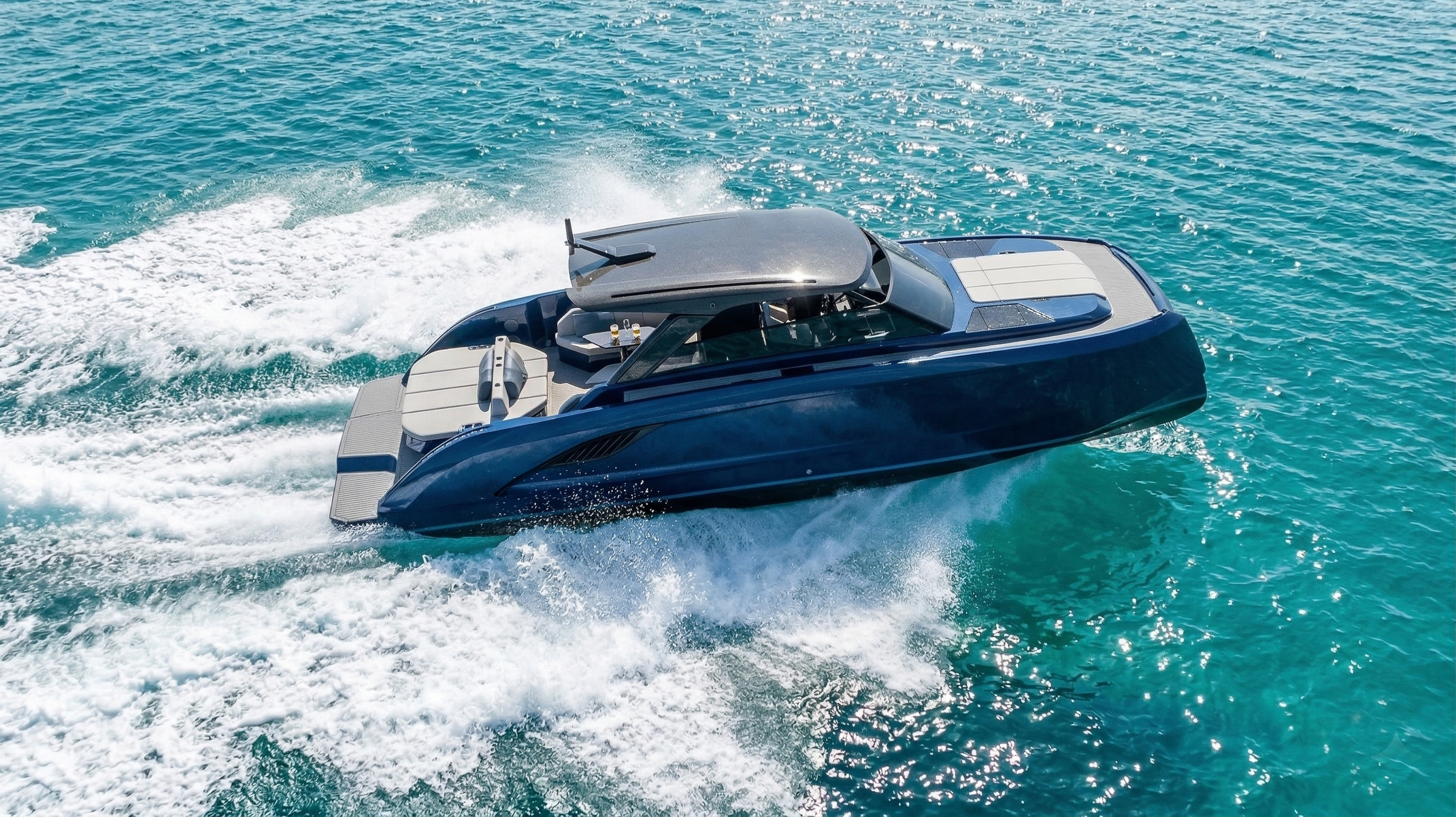
The hull is built using vacuum-infused E-glass with strategic carbon fibre reinforcement at high-stress points — the keel line, engine mounts, and transom structure. This hybrid approach delivers the strength-to-weight ratio needed for performance without compromising the durability expected from a vessel built in Viareggio’s most experienced facilities.
Vacuum infusion is not simply a manufacturing technique — it’s a quality guarantee. By drawing resin through the dry fibre layup under controlled vacuum, the process ensures a consistent resin-to-fibre ratio throughout the entire laminate. The result is a hull with predictable structural properties from bow to transom, free of the resin-rich or resin-starved areas that hand layup inevitably produces. Every hull is monitored during infusion with pressure sensors at twelve points, and post-cure samples are tested for interlaminar shear strength and fibre volume fraction.
Key construction details include:
- Vacuum infusion for consistent laminate quality and optimal resin-to-fibre ratio — achieving fibre volumes of 55-60%, compared to 40-45% typical of hand layup
- Carbon fibre reinforcement at structural load paths, reducing weight where it matters most — saving 180kg compared to an all-E-glass structure of equivalent strength
- Closed-cell foam core in non-structural panels for superior insulation and stiffness, contributing to both acoustic comfort and thermal performance in the Mediterranean summer
- Integrated stringers bonded directly to the hull shell, creating a monocoque-like structural behaviour that distributes loads across the entire hull rather than concentrating them at discrete mounting points
The construction process takes place at specialised facilities in Viareggio’s shipyard district, under the supervision of engineers who have spent decades building vessels to the standards of Italian classification societies. Every hull undergoes a 47-point quality inspection before it leaves the facility — from laminate thickness measurements to gelcoat hardness testing, from structural alignment verification to running gear installation tolerances.
Propulsion Integration
A hull is only half the equation. The VYBE 43’s performance depends equally on how its twin Mercury V12 Verado outboard engines interact with the hull geometry — a relationship that was engineered, not merely assembled.
The engine mounting position, transom angle, and propeller depth were developed in conjunction with the hull form. The propellers operate in clean, undisturbed water flow — a detail that sounds simple but requires precise attention to the hull’s buttock lines and transom geometry. Disturbed water means cavitation. Cavitation means noise, vibration, and wasted energy. The VYBE 43 runs clean.
The Mercury V12 Verado was selected not only for its power output — 600 horsepower per unit, delivering a combined 1,200hp — but for its integration characteristics. The V12’s contrarotating propeller system eliminates torque steer, the natural tendency of a single-rotation propeller to pull the vessel to one side. Combined with the VYBE 43’s twin asymmetrical V hull, the result is a yacht that tracks straight and true at any speed, responding to the helm with a linearity that inspires confidence in all conditions.
The engine management system communicates with the vessel’s integrated electronics, providing real-time data on fuel consumption, engine load, and range prediction. At 28 knots cruise, fuel consumption is optimised by the hull’s low resistance at that speed — a sweet spot where the hull is fully on plane, the waterline length is at maximum efficiency, and the engines operate at 65% load. This is engineering harmony: hull, propulsion, and operating profile aligned.
“Performance should never come at the expense of experience. The VYBE 43 proves they’re the same thing.”
Noise and Vibration Engineering
Speed creates noise. In most sport yachts, the transition from displacement to planing speeds is accompanied by a dramatic increase in cockpit noise — engine exhaust, wind buffeting, hull impact, and structural resonance combining to create an environment that demands raised voices and limits enjoyment.
The VYBE 43 approaches noise not as an inevitable consequence of performance but as an engineering problem with engineering solutions. The acoustic programme addresses four distinct noise paths:
Structural transmission is managed through the foam-core sandwich construction in non-structural panels, which acts as an acoustic break between the hull shell and the interior surfaces. The closed-cell foam absorbs vibration energy that would otherwise propagate through solid laminate.
Airborne noise from the engines is attenuated by the Mercury V12’s integral acoustic enclosures, further supplemented by the transom geometry that directs exhaust noise aft and away from the cockpit.
Wind noise is controlled by the hardtop’s CFD-optimised profile, which maintains attached airflow across the cockpit opening. The windscreen angle and side panel geometry create a pressure zone that shields occupants without creating the turbulent recirculation that plagues poorly designed hardtops.
Hydrodynamic noise — the sound of water passing along the hull — is minimised by the hull’s smooth flow characteristics and the absence of discontinuities in the running surface. At cruising speed, the dominant sound is wind passing over the structure, not water impacting it. This is the acoustic signature of a well-designed hull.
Performance Meets Efficiency
The numbers tell part of the story: 40+ knots top speed, 28 knots comfortable cruise, and a range that makes island-hopping across the Balearics or the Greek Cyclades a single-tank affair. With a fuel capacity of 1,200 litres and the hull’s efficient planing characteristics, the VYBE 43 delivers approximately 320 nautical miles at cruise speed — enough to cover Palma de Mallorca to Ibiza and back with comfortable reserves, or to transit from Naples to the Aeolian Islands without a fuel stop.
But numbers don’t capture the feel — the way the VYBE 43 settles into a groove at 30 knots, the hull singing rather than pounding, the wake clean and narrow. There’s a speed at which every hull finds its natural rhythm, where resistance flattens and the vessel seems to accelerate by simply relaxing into the water. For the VYBE 43, that speed is approximately 28-32 knots — a broad, forgiving sweet spot that makes cruising intuitive rather than demanding.
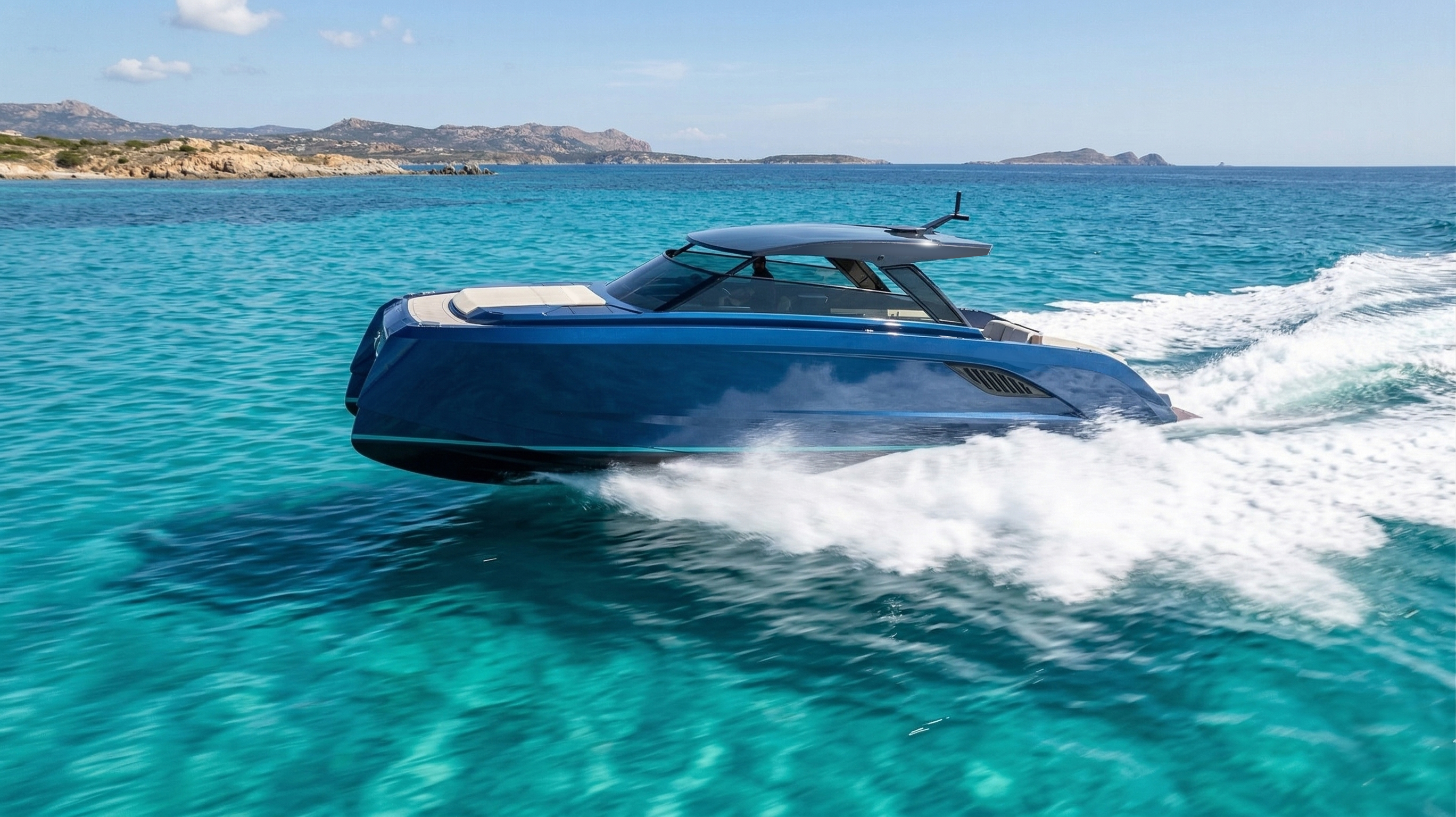
At top speed, the hull remains composed. The twin asymmetrical V geometry provides increasing stability as speed builds, countering the tendency of conventional hulls to become light and skittish above 35 knots. The VYBE 43 at 40 knots feels planted, confident, predictable — qualities that allow the skipper to focus on the sea and the scenery rather than the act of driving.
This is engineering with a point of view: that performance should never come at the expense of experience, and that the truest measure of a yacht’s capability isn’t its top speed but the speed at which it’s most pleasurable to travel.
Built for Real Conditions
The Mediterranean is not a uniform body of water. Between the mistral winds of the Golfe du Lion, the afternoon chop of the Strait of Bonifacio, and the confused seas around Cape Sounion, a hull must be versatile. Paper specifications and calm-water performance mean little when the sea decides otherwise.
The VYBE 43’s geometry was specifically optimised for these real-world conditions — not the calm-water conditions that flatter specification sheets but rarely match reality. The variable deadrise geometry adapts to sea state naturally: in flat water, the flatter transom sections provide maximum speed and efficiency; in chop, the sharper midship sections take over, absorbing impacts and maintaining the hull’s forward progress without the jarring deceleration that characterises lesser designs.
Specific sea states were modelled during the CFD development phase: a 0.8-metre wind sea with 4-second period (typical of the afternoon thermal wind along the Versilia coast), a 1.2-metre swell with 7-second period (representative of the open Tyrrhenian crossing to Corsica), and a confused cross-sea combining wind-driven chop with residual swell (the condition encountered off the north coast of Sardinia when the mistral meets the Tyrrhenian current). In each condition, the hull’s motion characteristics — pitch acceleration, roll amplitude, and vertical acceleration at the bow — were within the thresholds established by the ISO 2631 comfort standard.
Every VYBE 43 hull is built and finished at specialised facilities in the Viareggio shipyard district, under the same standards applied to vessels three times its length. The hull isn’t just a structure — it’s the foundation of every experience aboard. And foundations, in Viareggio, are built to last.
Continue Exploring
Discover More
Explore the craftsmanship and innovation behind every VYBE.